martes, 27 de febrero de 2018

Safety & Emergency: Life Saving Equipments on board


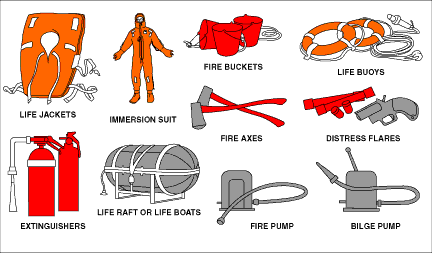
All ships must carry certain emergency and life-saving equipment. This equipment must meet minimum standards and must be properly tested and serviced.
There are different requirements depending on the size and type of ship and where it operates.
Emergency and life-saving equipment include things like:
  • lifeboats and liferafts
  • lifebuoys
  • lifejackets and attachments
  • buoyancy apparatus
  • emergency alarm systems and public address systems
  • marine evacuation systems
  • two-way VHF radiotelephone sets
  • fire-fighting equipment

Source: https://www.gov.uk/emergency-and-lifesaving-equipment-on-ships


Life Saving Appliances Equipments -LSA (video)


EXERCISES


Safety & Emergency: Signs objectives


Safety signs on board ship alert the crew to hazards, equipment, escape routes, etc. 
The intention of International Standards relating to signage is to communicate the safety message using graphical symbols and colours that are universally understood and known by all members of society, thereby removing one of the barriers to good safety management created by different languages.


lunes, 26 de febrero de 2018

Safety & Emergency: Life-Saving Appliances


Life-Saving Appliances, 2010 Edition, just published


Briefing: 53/2010, November 9, 2010


13

The 2010 edition of Life Saving Appliances is now available from the International Maritime Organization (IMO).
This publication includes the latest consolidated versions of the mandatory International Life-Saving Appliance (LSA) Code, the Revised Recommendation on Testing of Life-Saving Appliances and the Code of Practice for the Evaluation, Testing and Acceptance of Prototype Novel Life-Saving Appliances.
The updated requirements and recommendations in the new edition include those relating to:  

• stowage, fitting and equipment of liferafts;
• certification and fitting of lifeboats;
• new requirements for fast rescue boats;
• requirements for lifeboat and rescue boat launching appliances;
• carrying capacity of free-fall lifeboats;
• changes in the average weight of persons to be used for the design and equipment of life-saving appliances;
• extensive new requirements for lifejackets, including the introduction of infant and child lifejackets;
• extensive associated changes to testing requirements for life-saving appliances, including the introduction of reference test devices.


http://www.imo.org/MediaCentre/PressBriefings/Pages/Life-Saving-Appliances-2010-Edition.aspx

Life-Saving Appliances

Vocabulary


Roles and Duties on board

Captain (or Master)
The Captain is in command of the ship and is responsible for the safety of all crew and the vessel.

Mate (or 1st Mate, 1st Officer)
The Mate is in charge of the onboard day to day running of the ship. The Mate is also the Ship’s Safety and Security Officer.

2nd Mate (or 2nd Officer)
The 2nd Mate is the onboard Navigator responsible for maintaining up to date navigational information.

Bosun (or 3rd Mate / Officer)
The Bosun looks after the maintenance of the ondeck areas, the rigging and the sails.

Chief Engineer 
The Chief Engineer is in charge of the engineering dept and responsible for the upkeep of all engineering systems.

2nd Engineer
The 2nd Engineer does all the daily routine checks.

Medical Purser
The Medical Purser is the on board nurse (RGN) responsible for the medical side of things.

Cook and Cook’s Assistant
Usually we have one Cook’s Assistant per trip who is also a volunteer. As the job title suggests, the Cook’s Assistant helps the Cook keep everyone on board well fed.


martes, 7 de noviembre de 2017

RADAR SCREEN


Radar is an object-detection system which uses radio waves to determine the range, altitude, direction, or speed of objects. It can be used to detect aircraft, ships, spacecraft, guided missiles, motor vehicles, weather formations, and terrain.


RADAR SCREEN - VOCABULARY

  • HEAD MARKER: Línea de Proa
  • STERN MARKER: Línea de Popa
  • SWEEP: Barrido de pantalla
  • CROSS: Cruz
  • AUTOACQUIRE: Automático por defecto
  • PLOT: Ploteo
  • TRUE VECTOR: Vector Verdadero
  • RINGS OFF: Quitar anillos
  • COLLISION WARNING: Aviso de colisión
  • NEW TARGET: Blanco nuevo (nuevo barco)
  • LOST TARGET: Blanco perdido
  • COURSE UP: Curso arriba
  • VRM - VARIABLE RANGE MARKER:  Línea variable 
  • OWN HISTORY: Ruta propia (historia propia)
  • HEADING: Rumbo/ Proa
  • NORTH UP: Norte arriba
  • TRUE SCALE: Escala verdadera
  • RANGE: Distancia

RADAR